Mark-scheme reasons, per question
Each question is marked with the reason tied to the mark scheme, for example 'the correct term is chemical', not just a tick or a cross.
ilmino marks each submission in seconds and opens it in a split review view: the student's paper on one side, the AI marking on the other. Every question gets a mark, a mark-scheme-aligned reason and a confidence score, across typed and handwritten answers, so teachers verify results faster than marking by hand and accept or override with one click.
See AI marking in action →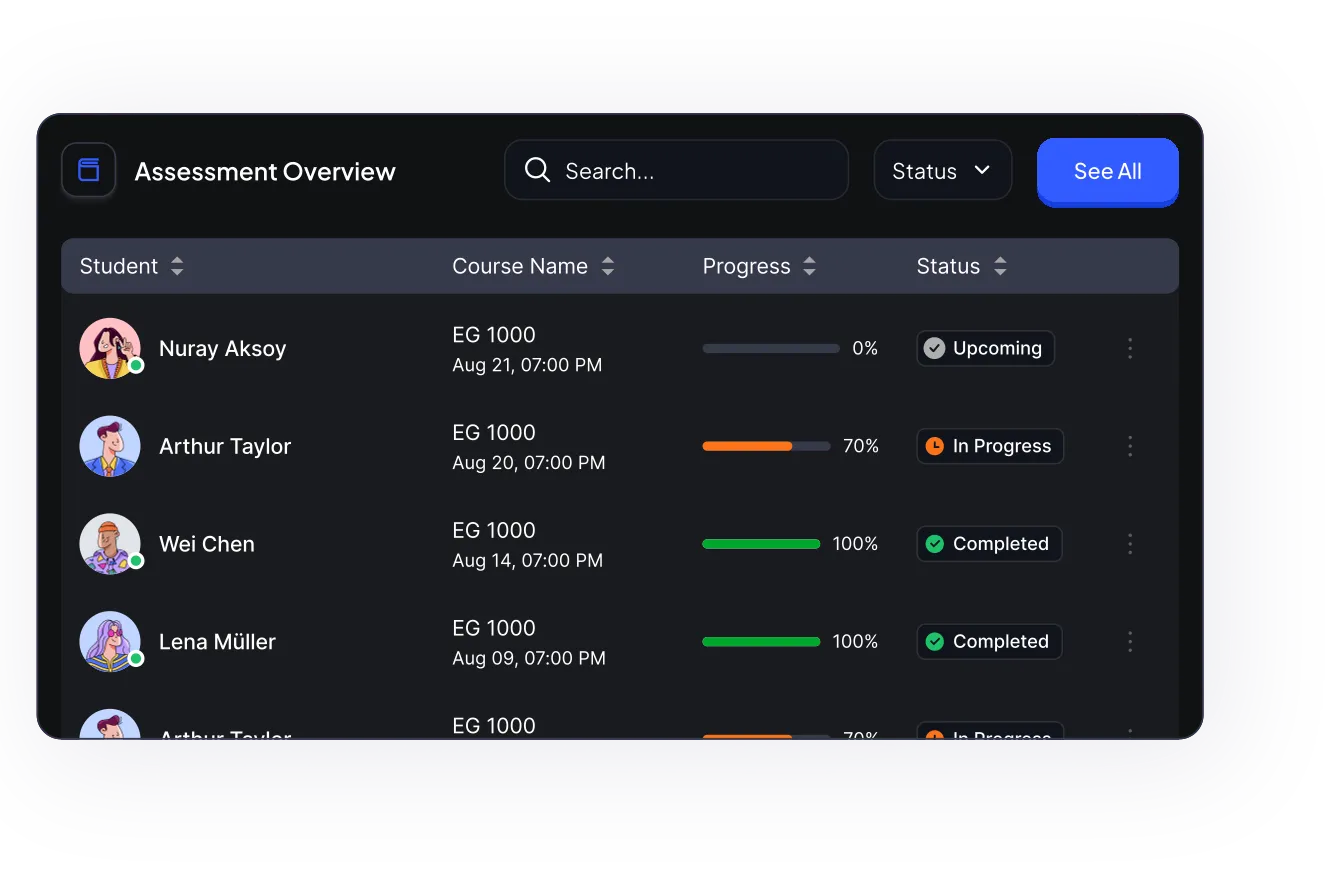
The assessment overview: every submission marked, scored and ready for teacher review in one place.
Marking is one of the biggest drains on teacher time, and it's usually the first thing to fall behind when workload spikes.
Each question is marked with the reason tied to the mark scheme, for example 'the correct term is chemical', not just a tick or a cross.
Reads handwritten working and typed answers alike, marking the method step by step rather than only the final answer.
Every submission carries a confidence level and a short 'where to improve' summary, so teachers know which marks to check first.
Accept the AI score, or override it with a manual score and comments; the manual score updates as you adjust marks on the paper, and teacher judgement has the final say.
Students submit homework, tests or exam-style questions, typed or handwritten, through ilmino.
ilmino marks every question against the mark scheme, with a reason, a confidence level and the full working shown.
Teachers open the split review view, check flagged or low-confidence answers, and edit marks directly on the paper.
Accept the AI score or save a manual review with a score and comments; results and feedback publish to students and feed analytics.
AI-assisted marking with teacher review where needed, teachers can see every mark, override any score, and stay in control of what reaches a student.
One instruction, orchestrated across specialist agents that plan, generate, mark and report, with the teacher in control at every step.
As the cyclist accelerates, the elastic potential ✗ energy store decreases and the kinetic energy increases.
0.5 × 80 × 12² = 5760 J ✓
Strong calculation in 1.2. Revise energy stores for 1.1: the store that decreases is chemical, not elastic potential.
Accept the AI score, or override it with a manual score and comments.
Mark my Year 10 physics mocks and draft personalised feedback for every student, then publish to GCGoogle Classroom